




Evaporative cooling or reverse cycle air conditioning? Compare costs, comfort and climate suitability.
Choosing between an evaporative and a reverse cycle for your home is a tough decision. It isn’t about which system is universally “better” – it’s about which one suits your climate, home design and long-term running costs.
In Australia, evaporative cooling generally performs best in hot, dry climates, while reverse cycle systems offer more flexibility across humid, coastal and mixed-weather regions. Factors such as insulation, airflow and how different rooms are used can also influence which system performs best in your home.
At Seeley International, we’ve equipped thousands of homes around Australia with these cooling systems. Here’s a practical comparison to help you choose the right option for your home and climate.
A Short Introduction to Reverse Cycle and Evaporative Cooling
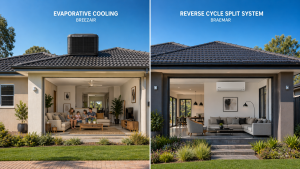
Before we compare both, here’s a quick summary of how these systems work in your home.
How a Reverse Cycle Air Conditioner Works
A reverse cycle AC is a heating plus cooling system that extracts heat from inside your home and releases it outside, using a refrigerant. In winter, it does the exact opposite (extracting heat from outside and bringing it inside) to keep your home warm.
Reverse cycle systems are made for closed environments, so your windows and doors need to stay closed. Homeowners enjoy them because they work in any weather, and because one system handles both heating and cooling, there’s no need for a separate heater.
Modern reverse cycle systems are also designed with inverter technology, zoning controls and energy-efficiency improvements that help reduce long-term running costs while maintaining more consistent temperatures throughout the home.
How Evaporative Cooling Works
Evaporative cooling systems take the hot outside air and transfer it into your home. Air passes through water-saturated pads and goes through an evaporative process to cool down its temperature. This cool air is then distributed through your home via ducts.
For this process to work, your home windows and doors should be open to allow maximum airflow. Many homeowners enjoy this too, as evaporative cooling brings fresh outside air rather than recirculating indoor air.
This constant airflow and ventilation can help create a fresher indoor environment during summer, particularly in larger homes or open-plan living areas.
When comparing evaporative and reverse cycle systems, most homeowners look at climate suitability, running costs, installation requirements and how the system will perform in their day-to-day lifestyle.
Climate: Where Each System Performs Best Across Australia
So which systems are suitable for your home? It depends on where you live in Australia.
Evaporative cooling is great for hot, dry climates like Perth, Adelaide, inland Victoria and regional NSW. These areas have low humidity, which is an ideal condition for evaporative cooling. Our evaporative systems see very little uptake in areas like metro NSW, where coastal humidity makes them less reliable. Humidity levels have a major impact on cooling performance. Dry climates allow the evaporation process to work much more efficiently.
Reverse cycle air conditioners are great for all Australian weather. Our reverse cycle systems are particularly popular in Queensland, where subtropical humidity makes evaporative cooling impractical for much of the year. Reverse cycle systems are also popular in homes where both heating and cooling are needed throughout the year, making them a flexible option for changing seasonal conditions.
If you’re in Melbourne or Adelaide, either system can work well for most of the summer. But on some days when a “cool, humid change” rolls through, a reverse cycle system can be a better choice. This is where home insulation, ceiling height, zoning and overall home design can also influence which system performs best over time.
Running Costs: Evaporative vs Reverse Cycle Cooling
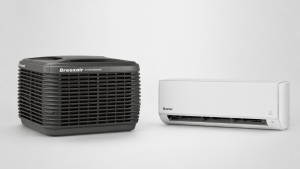
Evaporative cooling is cheaper to run than reverse cycle. A reverse cycle system runs on a compressor, which uses significantly more electricity. If you’re in a dry climate and running your cooling systems regularly, then evaporative systems can be more cost-effective. Although, running costs are influenced by more than electricity usage alone. Insulation quality, climate conditions, thermostat settings, zoning and how often the system operates all affect long-term energy consumption.
Modern reverse cycle systems have also significantly improved in efficiency, and their Energy Star ratings are worth paying attention to when comparing models. Reverse cycle systems also cover winter heating, which means you’re not running a separate gas heater during the colder months.
For homes with solar panels, running costs can become significantly more manageable during daylight hours, especially when cooling demand is highest.
Evaporative systems use water continuously, which is worth considering if you’re already dealing with high water bills or restrictions.
As residential cooling specialists, we see many customers focusing only on running costs. Installation and maintenance costs are also important when comparing long-term value.
Installation and Maintenance Costs
If you’re comparing costs at the whole-home level, evaporative cooling has lower purchase and installation costs than a ducted reverse-cycle system. However, maintenance can be slightly more costly for evaporative systems, and you’ll also need to connect them to a water supply.
A ducted or split-system reverse cycle unit has a higher upfront installation cost and is more expensive to run than an evaporative. But it needs less maintenance, has both heating and cooling, and you can offset this with solar.
Split-system reverse cycle units are also popular in apartments, smaller homes or households where only certain rooms need regular cooling or heating.
It’s important to note here that both systems are available in ducted whole-home configurations. Reverse-cycle systems also come as split systems for individual rooms, which is worth considering for smaller homes or apartments where a full ducted install isn’t necessary.
Evaporative vs Reverse Cycle: Comparing Seeley’s Cooling Systems
Seeley International manufactures both evaporative and reverse cycle systems. Our Breezair brand specialises in evaporative cooling, while our Braemar systems has both evaporative and reverse-cycle options. Here’s a quick comparison of both.
| Feature | Evaporative Cooling | Reverse Cycle |
| Function | Cooling only | Heating + cooling |
| Best climate | Hot, dry (low humidity). Used during summer. | All Australian climates. Used during summer and winter. |
| Running cost | Lower but has a higher maintenance cost and water usage. | Higher running costs, but can be offset by newer, more efficient systems and solar |
| Heating capability | No | Yes — year-round comfort |
| Installation | Rooftop unit + ducting | Split system or ducted options |
| Water usage | Yes. Requires connection to a water supply. | No |
| Ventilation | Fresh outside air | Recirculated indoor air |
| Suited to | Inland/dry regions | All regions, especially coastal & humid |
| Seeley brands | Breezair, Braemar | Braemar |
In Summary: Which System Is Right for Your Home?
Here’s a quick summary of which systems are good for your home:
Choose evaporative cooling if:
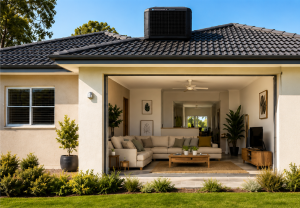
- You want to keep windows and doors open and have ventilation.
- You live in a hot, dry climate (eg: Perth)
- You want lower daily running costs
- You’re comfortable with a cooling-only system
- You have a larger home and want to go with a ducted system
Choose a reverse cycle air conditioner if:
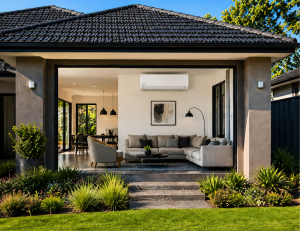
- You live in a humid climate
- You want a system that handles both cooling and heating
- You have a sealed, well-insulated home
- You need reliable cooling when the days are very humid
- You have solar panels and can run the system during the day at a low cost
The Right System Is the One That Fits Your Home
There’s no universally “best” cooling system, and it’s important that you choose one that’s unique to your home and climate. Both our Breezair and Braemar cooling brands are designed and built for Aussie homes and climates.
The best cooling system is usually the one that aligns with your climate, home layout, comfort expectations and long-term running costs.
If you’re not sure which system works best for your home, we have a Help Me Choose tool that pairs you with the right system with just a few questions. Alternatively, call our residential sales team at 1300 360 815.
Frequently Asked Questions
What is the difference between evaporative cooling and reverse cycle air conditioning?
Evaporative cooling uses fresh outside air and water evaporation to cool your home, making it best suited to hot, dry climates. Reverse cycle systems use refrigerant technology and work in almost all climates while also providing heating during winter.
Which cooling system is cheaper to run in Australia?
Evaporative cooling is generally cheaper to run in dry climates because it uses significantly less electricity than reverse cycle systems. However, reverse cycle systems can become more cost-effective when paired with solar panels and energy-efficient settings.
What cooling system works best with solar?
Reverse cycle systems are often a strong match for solar-powered homes because they operate on electricity and can make use of daytime solar generation.
Is evaporative cooling better for large homes?
Evaporative cooling is often well suited to larger homes and open-plan layouts because it provides whole-home airflow and lower running costs in dry climates.
Can reverse cycle systems replace gas heating?
Yes. Many homeowners now use reverse cycle systems as their primary heating solution during winter, especially with modern energy-efficient systems and solar integration.
Can I use evaporative cooling in humid weather?
We don’t recommend evaporative cooling systems in humid climates. On humid days, the air already holds too much moisture for evaporation to happen. Evaporation works best when the outside air is dry, so the system will humidify a room without lowering the temperature.
Is a reverse cycle air conditioner worth it if I already have evaporative cooling?
Yes, because having both covers all scenarios. Use your evaporative system on hot, dry days to keep the power bill low, and switch to reverse cycle when it’s more humid or when you need heating in winter.
Do I need to choose between a ducted and split system?
Generally yes, because they are made for different purposes. Ducted systems are made for whole-home cooling, while split systems are better suited to individual rooms or smaller homes.