

Fresh air cooling performs well in dry climates, delivering 100% fresh air and lower running costs.

If you’re in the market for a fresh air cooling system, it’s important to choose the right one for your home. Different parts of Australia have varying cooling needs, and choosing the right system can improve comfort while helping reduce running costs.
Fresh air cooling (or evaporative cooling) is one of the most popular cooling systems among Aussie households. Here’s how it works, where it performs best, and which systems are worth knowing about.
How Does Fresh Air Cooling Work?
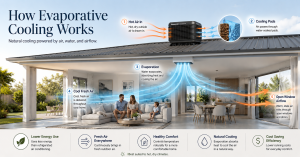
Fresh air cooling is a form of evaporative cooling that cools your home through evaporation. Hot and dry outside air is drawn into the system through water-infused cooling pads. As the air is pushed through the cooling pads, the water undergoes evaporation, which lowers the air temperature. A fan then pushes the cool air throughout the home via a network of ducts.
Fresh-air cooling works best when the air outside is dry. So if your home is in a low-humidity climate like Adelaide and Perth, having an evaporative cooler always works to your benefit.
Customers also choose evaporative coolers for better air quality. Evaporative systems constantly push fresh outside air through your home, which means you’re not recirculating stale air and always get 100% fresh air.
How Does Fresh-Air Cooling Compare to Reverse Cycle?
The two biggest differences between fresh air cooling and reverse cycles are air quality and running costs. Reverse cycle systems recirculate the same indoor air, while evaporative systems pump a continuous stream of fresh outside air through the home. This means you can leave your doors and windows open while enjoying filtered air in your home.
An important caveat is that evaporative coolers use water, so household water consumption will increase. However, in many Australian climates, the reduction in electricity use can outweigh the additional water costs.
How Much Can You Save Running an Evaporative System?
Modern fresh-air cooling systems like the Breezair Supercool® EXS Series can cut running costs by 85% compared to a 1.5-star, non-zoned ducted refrigerated system. We tested this in a large 220 m² home built before 2005 in the Melbourne climate, with the system running all day on weekends and in the morning/evening on weekdays. The system was also tested at an electricity tariff of 29.30c/kWh.
An important caveat is that evaporative coolers use water, so household water consumption will increase. However, in many Australian climates, the reduction in electricity use can outweigh the additional water costs.
Which Australian Regions Are Best Suited to Fresh-Air Cooling?
Fresh-air cooling works in all the dry regions of Australia. States like Perth, outer Victoria, and South Australia all fit that profile well, as they regularly see hot, low-humidity days.
Tropical north Queensland and high-humidity coastal zones are a different story. When humidity is consistently high, evaporation becomes difficult, and these fresh air cooling systems don’t work effectively.
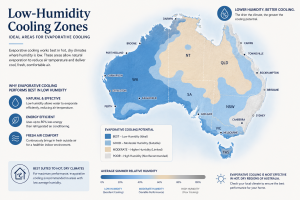
Homes that sit somewhere in the middle usually choose a hybrid setup. These households use a ducted evaporative system as their main cooling solution and install a few split systems in key rooms to handle occasional humid stretches or to provide heating. There are also systems like the Climate Wizard® CW3 that can combine evaporative cooling with a home’s existing gas systems.
The Technology Behind Seeley’s Fresh Air Cooling Brands
At Seeley International, we have a range of fresh-air cooling systems guaranteed to provide higher-quality air. Here’s a breakdown of our popular brands: Breezair and Climate Wizard.
Breezair Extraordinaire™ XTR Series
The Extraordinaire™ is Breezair’s top-of-the-range system. It uses a SuperStealth® axial fan, which is designed to run quietly without sacrificing airflow. It’s also built with an innovative Black Magic® MINI-CELL Chillcel® pad that can maximise cooling without increasing the unit’s size.
Cooling output for this system reaches 17.4kW and 2,900 litres per second, with a cooling pad area of 2.1 square meters.
Breezair Supercool® EXS Series
For smaller homes, the Supercool® series has an output of 15.1kW and 2,540 litres per second. The EXS200 and EXS220 models come with extra-thick Chillcel® pads that have better cooling performance on hot days. Like the Extraordinaire™ series, it’s highly energy efficient and quiet.
Climate Wizard® CW3 Dual System
The CW3 Dual is Seeley International’s most advanced fresh-air cooling system with an optional heating add-on. The system operates as a standalone evaporative cooling unit or can be paired with an existing gas heater to transfer warm air through the same ducts and small ceiling vents. It’s a good option for homes in areas that swing between dry and humid through the season.
Benefits of Fresh Air Cooling for Homes in Australia
In summary, here are some of the major benefits of fresh air cooling and evaporative systems for Australian homes:
- Lower running costs compared to typical reverse cycle air conditioners
- 100% fresh air from the outside, which reduces indoor stale air
- Modern systems are quiet to run and don’t use much water
- Doors and windows can be opened
- Systems like the Climate Wizard CW3 can be customised to efficiently heat homes with existing gas systems.
If you’re ready to compare options, browse our Breezair Extraordinaire™, Breezair Supercool®, and Climate Wizard® CW3 systems. Alternatively, speak to one of our residential sales representatives at 1300 360 815, and we’d be happy to help.
Frequently Asked Questions
Does fresh air cooling still work on extremely hot days above 40°C?
Yes, as long as the air stays dry. The hotter and drier the air, the more effective evaporative cooling becomes because there’s a greater temperature difference between incoming and cooled air. The only exception is during those hot days with high humidity, as this can reduce the efficiency of fresh air cooling systems.
Can I run an evaporative cooler with my windows and doors closed?
No. Evaporative cooling works by pumping fresh, moisture-laden air into your home and pushing hot, stale air out. If the house is sealed, that air has nowhere to go, and the system can’t circulate effectively. Windows and doors should be partially open while the system runs. However, systems like the Breezair Supercool® do have an optional security relief vent for households that need to close their doors and windows for security.
How often does an evaporative cooler need to be serviced?
Once a year is our general recommendation to service your cooling systems. A professional service usually covers the pads, water distribution system, pump, and motor, and prevents issues. We also recommend servicing before the summer season. temperatures in different rooms.
How much does it cost to install a ducted evaporative cooling system in an Australian home?
Installation costs vary depending on the size of your home, the ductwork required, and whether multiple units are needed. These costs can be anywhere between $3,000 to $10,000, but there’s no single answer that applies to everyone. The best approach is to contact your nearest Seeley International dealer, who can assess your home and provide an accurate quote for your specific setup.